

DEEP DIVES | Disaster Relief or Revolutionary Strategy?
PART ONE
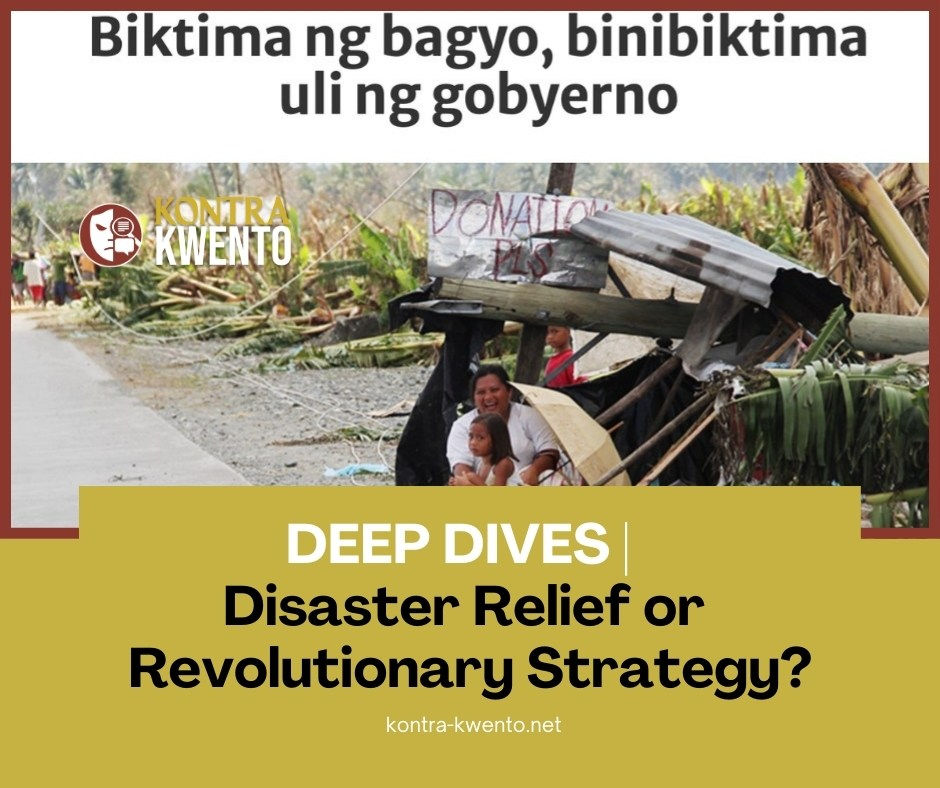
On December 4, 2012, Southern Mindanao woke to a kind of devastation it had not seen in a generation. Super Typhoon Pablo (international name Bopha), carrying winds of up to 280 km/h, tore across Davao Oriental and Compostela Valley (now Davao de Oro) with the violence of a hammer dropped from the sky. Entire mountainsides in New Bataan, ComVal collapsed into rivers of mud. Coconut fields in Cateel and Boston, Davao Oriental that had stood for decades were snapped like matchsticks. Tens of thousands of families were left grieving, uprooted, or wandering through debris in search of relatives who would never be found.
In the first weeks after the catastrophe, the landscape was defined only by loss: of communities pleading for relief, local governments overwhelmed, and humanitarian workers racing against time. But in the months that followed, something else began to move quietly beneath the surface. Where most saw tragedy, the Communist Party of the Philippines - New People’s Army - National Democratic Front (CPP–NPA–NDF) saw an opening.
Former cadres say that Typhoon Pablo became one of the biggest post-calamity watershed moments ever utilized by the revolutionary movement in Southern Mindanao at the time. The storm’s aftermath created ideal conditions for the CPP’s calls for recovery, expansion, and consolidation work: the consolidation of old “anemic” mass bases, the establishment of new ones, and the subtle re-entry of guerrilla units into communities that were once antagonistic to the CPP-NPA. Relief missions evolved into political missions where humanitarian corridors were established as pathways for reorganizing the infrastructure of armed struggle.
Pablo was not the first time this happened, and nor would it be the last. What it revealed was a pattern of the duality of disaster relief as both aid and agenda, both compassion and strategy.
As we mark the 13th anniversary of Super Typhoon Pablo, the strongest typhoon ever to hit Mindanao, this Deep Dive looks back at the lessons the disaster left behind. Beyond its catastrophic destruction and the pressing need for the government to step up its disaster preparedness game, Pablo also exposed how calamities can be weaponized within the revolutionary strategy. Thirteen years later, the question is no longer just how the movement used the tragedy, but what we can do today to ensure that future disasters—like the series of earthquakes that hit Mindanao and recent typhoons that battered Luzon and Visayas—are not turned into political footholds.
A Two-Front Strategy
The CPP’s strategy thrives on synchronized urban and rural mobilization. The White Area consists of NGOs, student organizations, church networks, and other sectors engaging in legal struggle. The "Red Area" involves the NPA guerilla fronts and underground mass organizations in the countryside.
As practice, these two fronts reinforce each other in a symbiotic, albeit clandestine, relationship. During disasters, White Area actors enter communities under humanitarian banners and deploy volunteers to gather data, conduct social mapping, and carry out community surveys. The Red Area then uses this information to assess the feasibility of re-entry, rebuild influence, and plan movement routes.
In this way, a disaster does more than expose community vulnerabilities. It also becomes the bridge that links the legal and the clandestine components of the revolutionary movement.
The Duality of Disaster Relief
On the surface, the legal progressive organizations that mobilize volunteers during disasters offer something undeniably good. They provide food packs, medical missions, psychosocial support, and community rehabilitation.
But beneath many of these humanitarian networks stand Party cadres. These are organizers of the CPP who operate within legal organizations to lead or influence NGOs, youth groups, and alliances. They activate connections with church groups and student councils while mobilizing volunteers from the academe and labor sectors. Crucially, they link resources from funding agencies abroad, centralize these donations to the Party, and aid in the "creative credible reality" to hide the fact that some, if not most, of the funds go to the underground and armed operations and base building of the CPP-NPA.
Former rebels confirm that these missions are often designed to serve a dual purpose. As one former cadre described it, relief operations are not just for service. They are for "recovery work." In the Party’s lexicon, recovery means rebuilding old mass bases or preparing a new pipeline for the NPA’s return. This mirrors the tactic used in International Solidarity Missions, where humanitarian setups serve as "soft entry points" to expose potential recruits to the movement.
In the months following Typhoon Pablo, the upheaval in Southern Mindanao became fertile ground for political mobilization, orchestrated by the Southern Mindanao Regional Committee of the CPP. Survivors, desperate for relief and rehabilitation, were rallied into mass action. The tragedy became a mass weapon.
On January 15, 2013, around 5,000 typhoon victims reportedly blocked the national highway in Montevista, ComVal, forming a human barricade demanding genuine government assistance. Weeks later, in a display that would draw national and international attention, approximately 3,000 to 5,000 survivors stormed the regional office of Department of Social Welfare and Development (DSWD) in Davao City, seizing sacks of rice, noodles, and other relief goods.
What began as a humanitarian plea mutated into a forceful protest. Observers noted that the demonstration, led by a “relief network” established by the region’s CPP organ and aided by legal progressive organizations, carried the hallmarks of organized political agitation that would become a template for years to come.

Platforms for Underground Expansion and Consolidation
When a disaster hits, affected areas temporarily open their doors to anyone who brings help. Humanitarian missions can reach barangays where the NPA once operated but later abandoned due to military pressures. This “humanitarian access” becomes the perfect cover for political redeployment.
The CPP distinguishes two kinds of disaster-area entry. There are "Guerilla Prep Zones," which are areas being reconditioned to allow NPA entry for the first time. Then there are "Recovery Zones," where the NPA used to operate but lost influence. Disaster missions allow for re-entry.
Relief operations reopen conversations that had been cut off for years. Former contacts are located. Local guides are rekindled. Old sympathizers receive assistance while potential supporters are quietly mapped.
Pre-2012, the Southern Mindanao Regional Party Committee (SMRC) was already pointing to serious setbacks due to internal problems in base building. Its expansion areas were shrinking, and the development of its so-called “mass bases” in the countryside had begun to stagnate. When Typhoon Pablo struck, the calamity became an unexpected opening. It allowed the movement to revive expansion areas to widen mobility corridors for NPA units and to consolidate existing strongholds through an aggressive “relief and rehabilitation” campaign.
Through a newly formed relief network claiming to represent calamity survivors across Mindanao, the CPP mobilized both its underground and aboveground machinery to enter communities that had long been difficult to penetrate. Offering much-needed relief supplies and a seemingly viable rehabilitation plan, Party organizers reestablished contacts and built new underground structures, from organizing groups to committees, using a dual mass line that framed government response as inept and the revolutionary movement as savior.
Meanwhile, in the interior lines, underground organizations activated their legal fronts to demand greater national government support and to solicit international assistance for rebuilding homes and community infrastructure such as water systems, post-harvest facilities, health centers, and Lumad schools. In these campaigns, the NPA was publicly showcased as the “frontliners” of community relief, unintentionally revealing stronghold base areas. These exposures would later prove fatal to the revolutionary movement in the years that followed, especially during the government’s whole-of-nation approach.
But none of these gains would have been possible without the CPP’s establishment and intervention of relief networks and NGOs. These platforms provided the legal, logistical, and moral cover needed to move cadres and organizers across affected communities.
Over the past decade, the same strategy surfaced in other disaster zones. After the mass displacements in Northern Mindanao during Typhoon Sendong in 2011, and again in Eastern Visayas in the aftermath of Typhoon Yolanda, White Area cadres were able to barangays under the banner of humanitarian aid. The missions were packaged as relief operations, but the underlying objective remained political.

Financial Opportunities
Calamities draw donations from both local and international communities. Relief networks raise millions for humanitarian drives, and while much of this funding supports legitimate aid, former rebels acknowledge that a significant portion is diverted to sustain underground operations.
In Southern Mindanao, former cadres familiar with the campaign recount that a comprehensive rehabilitation plan was initially drafted by SMRC to be facilitated by the NDFP’s International Department in the Netherlands. The proposal sought around ₱30 billion in funding from one funder alone to rebuild homes, schools, health centers, and community facilities in severely affected base areas of the region’s Subregion 1, 2 and 4. It even included production and sustainable agriculture components under the Maoist concept of war economy, where the CPP–NPA would invest heavily in agricultural production to ensure food security as the “people’s war” intensified.
The plan, however, was eventually shelved, dismissed internally as “too ambitious,” and far too costly. In its place, a more modest and achievable campaign was rolled out, tapping various international funding agencies and non-government organizations.
International donors funded part of the campaign’s operational requirements, but local sources filled the rest, including revenue from “revolutionary taxation,” which was framed as necessary for relief and rehabilitation. Former rebels say that the SMRC’s income from taxation significantly increased after Pablo, partly due to the expanded access to communities and the heightened activity under the relief banner.
But the funding stream did not stop at community rehabilitation. It also strengthened the NPA’s combat readiness and arsenal. Former commanders and Party secretaries from Sub-Regions 1, 4, and 2 reveal that during and after the Pablo relief campaign, as new platoons were formed to cover expansion areas and reinforce base areas, the SMRC directed CPP and NPA units to ensure that revenue generated during the campaign would help sustain the growing army and its auxiliary groups.
This practice of financial diversion is well-documented. Former cadres consistently testify that funds raised through “humanitarian” proposals were often used to purchase field essentials such as radios, backpacks, rations, and other logistical necessities for NPA units. It is, as one described it, a form of “creative nonfiction,” where donations are reported as aid but quietly funneled to guerrilla fronts.
Part Two will explore how Typhoon Pablo became a springboard for advancing the three components of the people’s war and why early indicators suggest that the recent calamities, especially series of earthquakes in Davao Oriental last October, are being positioned as an opportunity to revive the dismantled the CPP’s Southern Mindanao Regional Party Committee.


Mga Komento