

DEEP DIVE | Fault Lines: Disaster, Relief, and the Politics of Recovery
PART TWO

If Part One showed how Super Typhoon Pablo became a turning point for the Communist Party of the P’s consolidation and recovery work in Southern Mindanao, Part Two asks a more urgent question: what happens when the same conditions reappear today? The armed structure that once carried out Pablo-era consolidation has been dismantled. Yet disasters continue. And with them, the same openings.
For the remaining cadres of the CPP, the answer lies in continuity, not of armed strength, but of organizational memory.
Why the Playbook Still Matters
By the second decade of the 2000s, the Southern Mindanao Regional Party Committee (SMRC) had suffered decisive military and political losses. Guerrilla fronts collapsed, commanders were neutralized, Red fighters surrendered, and declared base areas were dismantled. By October 2022, Davao region had been declared insurgency-free.
But as many former rebels insist, insurgencies do not survive on arms alone.
What is enduring is something less visible but no less potent: organizational muscle memory—the doctrines, practices, and mass-line instincts developed over decades and refined during crises like Typhoon Pablo. These were carried not only by NPA fighters, but by organizers embedded in urban communities, legal networks, and sectoral formations.
The aftermath of Pablo demonstrated how this muscle memory worked.

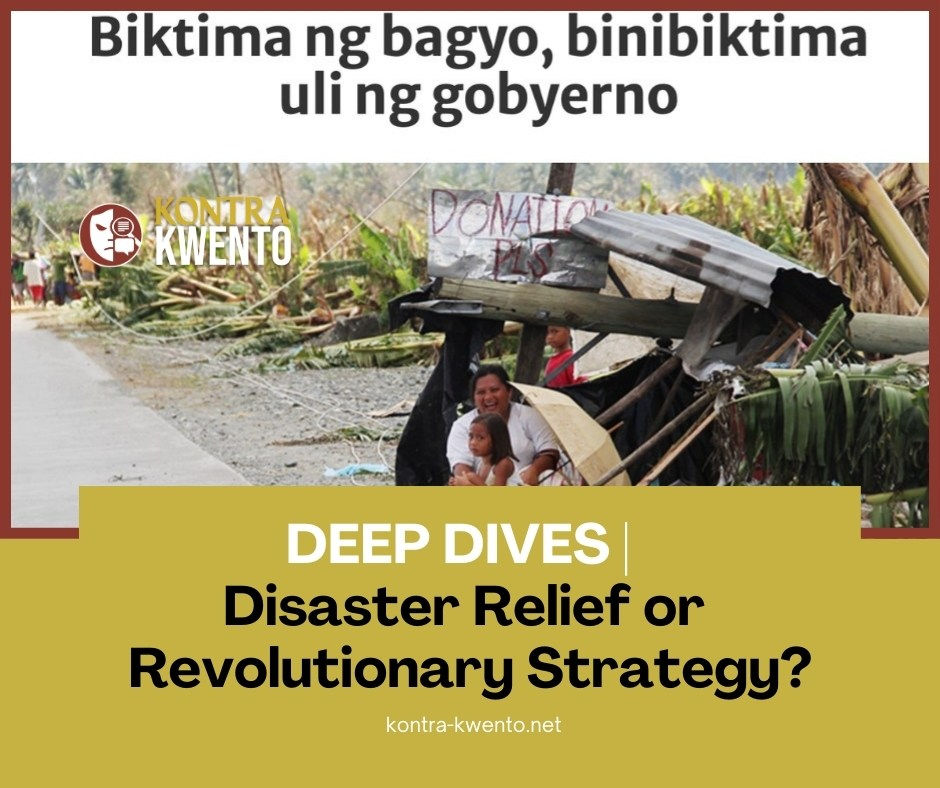
In the years following the typhoon, underground organizations in Compostela Valley moved beyond relief and rehabilitation toward something more ambitious: the formation of what they openly called organs of political power in the barrio and municipal levels.
In guerrilla bases deep in the provinces of Davao de Oro (then Compostela Valley) and Davao Oriental, CPP members marked the Party’s 45th anniversary by inducting officials of a parallel municipal structure, complete with a “revolutionary mayor,” sectoral committees, and service portfolios covering agriculture, health, education, and livelihood.
Former beneficiaries openly credited the Party for helping them “recover from the disaster brought about by Typhoon Pablo,” framing the revolutionary municipality as a response to what they described as state failure. Communal farming projects, housing reconstruction, and even weddings officiated by revolutionary officials were presented as proof that the movement had not only survived, but governed.
The CPP’s “symbiotic synergy” between its underground and aboveground machinery went into overdrive from 2013 to 2016. NPA fighters helped build (literally) Lumad schools, houses, and health centers, while the Party’s urban operators handled fundraising, international solidarity work, and alliance-building under the banner of relief, rebuilding, and rehabilitation.
What Pablo enabled, then, was not just recovery. It allowed the CPP to institutionalize influence, embedding political authority in the language of rehabilitation and survival.
If this was possible in the wake of a single typhoon, what happens when another disaster strikes today?
A New Opening
In early October, a series of earthquakes struck Davao Oriental, jolting coastal and upland municipalities that left damaged homes, disrupted livelihoods, and widespread anxiety. Communities in towns such as Manay reported cracked houses, compromised water systems, and families forced to temporarily evacuate or sleep outdoors for fear of aftershocks. Unlike typhoons, which arrive with warnings and established response protocols, earthquakes are abrupt and disorienting. They offer no seasonal preparation window and often catch both local governments and communities unready.
This unpredictability weakens security posture and coordination. Relief assessments take longer. Lines of authority blur. In the early days following the tremors, residents, especially in areas previously influenced by the CPP-NPA, described a humanitarian vacuum such as uneven aid distribution, delayed psychosocial services, and uncertainty about rehabilitation timelines. It is precisely in these moments of confusion that non-state actors, for better or worse, find room to maneuver. Within weeks, various relief missions began entering affected areas, framed under the language of climate justice, community solidarity, and support for Indigenous and women survivors.
One such effort was carried out by what former rebels identified as an alliance of organizations established by the CPP in Southern Mindanao, which undertook a relief mission for Mandaya-Lumad communities affected by the earthquakes. Public materials emphasized fundraising and relief distribution, while advancing a broader narrative of communities living under a “constant state of climate calamity.”
On the surface, these initiatives were humanitarian. But local accounts suggest that the context and composition of some activities warrant closer scrutiny.
Former rebels and people’s organizations in Manay, Davao Oriental, reported that on November 19, CPP-linked organizations conducted an activity under the vague title “emotional release for women survivors.” Residents said the organizers appeared more interested in discussing anti-government sentiments and probing the area’s socio-economic profile than in providing psychosocial support.
According to several former rebels who were once full-time CPP organizers, the gathering was notable less for its stated agenda than for the presence of individuals long associated with CPP urban-based organizing in the region.They identified several participants as known Party cadres, some of whom had previously joined NPA units operating in Southern Mindanao.
Residents also reported that the activity was conducted without prior coordination with local authorities, which raised questions about intent and transparency. Alongside these personalities were representatives from youth groups, Lumad advocacy organizations, labor formations, and women’s groups that have long been identified by former cadres and local monitors as aligned with CPP networks.
None of these observations, taken alone, constitute proof of recovery work. But viewed in historical context—disaster conditions, humanitarian framing, vague activity descriptions, lack of coordination, and the convergence of known organizers—they mirror patterns documented in earlier post-calamity interventions.
The earthquake, in other words, created the same conditions once exploited after Typhoon Pablo: vulnerability, access, and moral cover.
Early Indicators of Repositioning
What distinguishes humanitarian response from political repositioning is not intent declared, but patterns observed over time. Former rebels and community leaders point to several early indicators now emerging in disaster-prone areas across the country, including Davao region.
First is the rapid formation or reactivation of loosely defined relief coalitions, often branded as survivor- or sector-based networks. These groups tend to lack clear institutional accountability but enjoy broad narrative appeal, especially when framed around women, Indigenous peoples, or climate victims.
Second is the reappearance of familiar organizing faces, of individuals still actively involved in Party work, some resurfacing after years of low visibility. Their presence is often justified as volunteerism or advocacy, yet their organizing behavior follows well-worn mass-line practices: small group discussions, issue reframing, and identification of potential local contacts.
Third is selective engagement with hinterland barangays, particularly those with historic links to CPP activity or longstanding grievances. Aid distribution and follow-up visits are concentrated in these areas, reinforcing relationships that go beyond immediate relief.
Fourth is narrative framing. Disaster response is quickly linked to broader claims of state neglect, militarization, or structural injustice, subtly positioning revolutionary organizations as more responsive and empathetic than formal institutions.

None of these indicators confirm a revived insurgency. Together, however, they signal groundwork in the early phase of recovery work where visibility, trust, and legitimacy are quietly rebuilt. The CPP has always been willing to trade space for time, and protracted organizing is always a matter of patience, timing, and calculated re-entry.
Ethical Fault Lines and What Must Be Done
Most volunteers and humanitarian workers enter disaster zones with genuine intent. They seek to help, to listen, to provide relief where institutions fall short. But good intentions do not neutralize structural manipulation.
When humanitarian activities are used as vehicles for political repositioning, survivors risk becoming instruments rather than beneficiaries. Emotional support sessions become venues for ideological framing. Relief distribution doubles as reconnaissance and advocacy slips into recruitment.
For volunteers and NGOs, the moral challenge is not choosing sides, but knowing whose framework they are operating within. Transparency, coordination with local authorities, and clarity of purpose should not be bewailed as bureaucratic obstacles, but recognized as safeguards against exploitation, especially in previously conflict-affected areas.
The lesson from Pablo—and the warning from the masses of Davao Oriental—is not to securitize humanitarianism, but to protect it. Local governments must ensure rapid, visible response to prevent vacuums that others will fill. Civil society groups must practice due diligence, especially when partnering in disaster zones. Volunteers must ask hard questions about the organizations they work with and the narratives they carry.
Early detection does not mean repression. It means awareness. To be sure, disasters do not revive insurgencies on their own. But in the context of the CPP’s people’s war, they become openings only when vigilance collapses, coordination fails, and humanitarian spaces are left unguarded.
Mga Komento