

The Encounter Site Is Not a Coincidence: Chantal Anicoche and the CPP’s International Solidarity Playbook

Whether Chantal Anicoche is a plain civilian or an NPA cadre is, in the end, a secondary question, and perhaps a deliberately distracting one. The core issue lies elsewhere and cuts far deeper: why was she at the site of an armed encounter between state forces and the NPA in the first place? Who brought her there? For what purpose? And what role, if any, was she playing in a clearly hostile and militarized environment?
These questions matter more than labels. Civilians do not simply drift into active encounter zones by accident. Such areas are neither public spaces nor tourist destinations. They are controlled, monitored, and shaped by armed actors. Presence in such a space implies prior knowledge, direction, or coordination. To fixate on whether Chantal carried a firearm or wore an NPA uniform is to evade the more uncomfortable inquiry: what network placed her there, and why?
The contending narratives surrounding Chantal follow familiar fault lines. On one side are the legal nationalist democratic (ND) forces, portraying her as an innocent civilian victim of state repression. On the other hand, the 2nd Infantry Division (2ID) asserts that its presence cannot be separated from the armed underground. These narratives clash loudly in public, yet neither fully addresses the central issue. In reality, Chantal herself knew the real score of why she was in Mindoro, how she got there, and why she ended up under the custody of state forces. Purpose does not dissolve simply because controversy erupts.
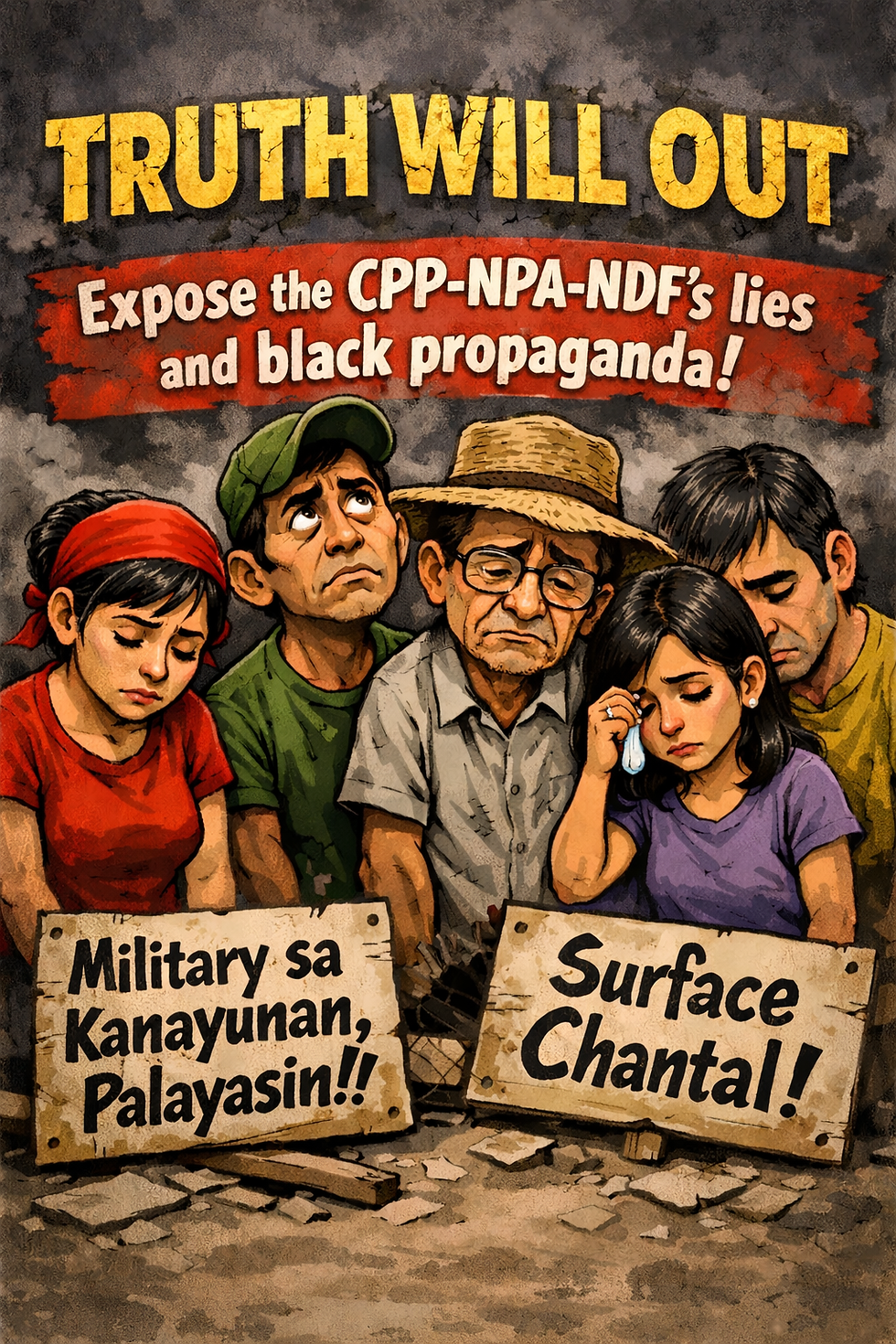
More telling is the reaction of the ND forces. They, too, knew why Chantal was there. Their swift and coordinated mobilization demanding her release, staging protests, and activating allied organizations, was not merely an expression of concern. It functioned as a rescue operation, designed to extract a politically compromised individual from the consequences of exposure. At the same time, it amounted to an implicit admission that Chantal’s presence in the encounter area was neither random nor incidental.
This becomes clearer when viewed against the CPP’s own operational framework. The CPP has long implemented an “adopt-a-region” program, under which foreign nationals and Filipino-Americans from various states in the United States, previously organized by the Party, are assigned to “adopt” specific CPP regional formations. Support is rendered in various forms, including propaganda work, fundraising, exposure missions, and direct revolutionary integration. For this purpose, the CPP designed a structured program of political exposure, revolutionary immersion, tour of duty and personnel deployment for organized foreign nationals and Fil-Ams in relation to the armed struggle in the Philippines.
In practical terms, this means that the CPP deliberately deploys individual foreign nationals and Fil-Ams into NPA units or NPA-influenced zones as part of its international solidarity work (ISW). This is not accidental, spontaneous, or humanitarian in nature. It is a calculated political and organizational undertaking. Seen in this light, Chantal’s presence in Mindoro was not incidental, just as her subsequent capture and the protest actions launched by CPP legal fronts were not isolated reactions.
Organizations such as Karapatan-ST, Anakbayan-ST, and other groups under the Makabayan Bloc were mobilized not simply out of compassion, but as part of a broader, rehearsed political response. Their campaign for Chantal’s release served two functions simultaneously: a tactical extraction effort and a public reframing operation meant to obscure the CPP’s direct involvement. Far from disproving CPP culpability, this mobilization reinforces it.
Ultimately, the Chantal Anicoche issue must be understood within the overall conduct of the CPP’s national democratic revolution, and more specifically, within its international solidarity work against the government’s anti-communist armed conflict campaign. The controversy is not about a lone individual caught in unfortunate circumstances; it is about a system that deliberately blurs the line between legality and armed struggle, civilian status and revolutionary function, foreign solidarity and operational participation.
Chantal knew why she was there. The ND forces knew why she was there. And the intensity and coordination of the response to her detention reveal not innocence, but anxiety over what her presence at that encounter site ultimately exposes.
With all the controversies surrounding the Chantal Anicoche issue, the CPP must be held squarely responsible for this mess. It is the Party that placed her in harm’s way, embedded her in a conflict zone, and then activated its machinery to deal with the fallout. The legal front organizations, especially those members who are not part of the underground movement, should seriously question why they were mobilized to “rescue” someone they only came to know after she was already in the custody of state forces. They should ask: who authorized this, who benefited from it, and who is being protected? At the very least, they must demand transparency, responsibility, and accountability from the CPP, instead of allowing themselves to be used as instruments of political maneuvering, narrative laundering, and organizational manipulation.


Mga Komento