

UNPOPULAR OPINION | UP Student Leaders’ Bad Romance with Armed Struggle

At the recent VotEng’g 2026 forum held at the Engineering Theater in Melchor Hall, candidates for the UP Diliman University Student Council once again revealed the troubling reality of the normalization—even romanticization—of armed struggle in UP student politics.
When asked about their stance on armed struggle, candidates from the “Sulong Tayo” coalition reportedly expressed affirmative positions, while most bets from UP Alyansa agreed with reservations. Regardless of nuance or qualification, the fact remains that future student leaders of the country’s premier state university openly entertained the legitimacy of armed struggle in the Philippine context.
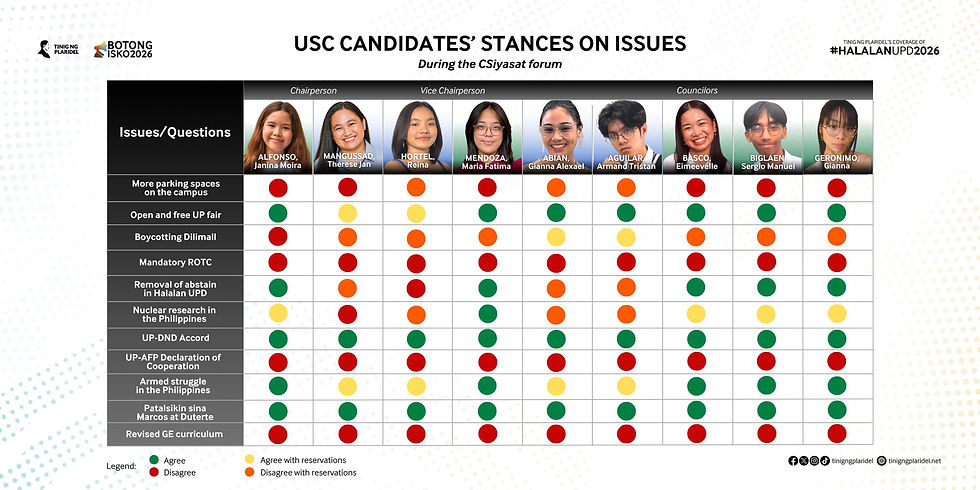
This becomes even more troubling when viewed alongside their other positions. Across the field, the candidates supported keeping the UP-DND Accord, rejected Mandatory ROTC, and opposed the UP-AFP Declaration of Cooperation. On their own, these positions may be defended as part of a broader anti-militarization stance in the university. They are valid subjects for debate in any democratic campus space.
But taken together with the refusal to clearly reject armed struggle, the pattern becomes harder to ignore. The candidates appear united in resisting formal military presence or military-related programs inside UP, yet none of them took the equally clear position of rejecting armed struggle as a political method. That imbalance deserves scrutiny.
It is easy to speak of “armed struggle” inside an air-conditioned theater hall in Diliman. It is easy to reduce it into ideological rhetoric. But outside the university, armed struggle means bloodshed, fear, coercion, and death in rural communities that have spent decades trapped between the New People’s Army and state forces.
Those student leaders casually affirming armed struggle today are dangerously detached from the realities of armed struggle.
Do these students understand what life inside the New People's Army actually entails? Do they understand the internal purges, the executions of suspected informants, the “revolutionary” taxation of farmers, the recruitment of minors, and organizational abuses? Do these students understand the growing disillusionment among ordinary masses in conflict-affected communities—farmers, laborers, and even former rebels—who have come to realize the futility of armed struggle as a vehicle for meaningful social change after decades of violence and sacrifice? Or is armed struggle merely a convenient and fashionable rhetoric to avoid being cancelled by National Democratic organizations?
The tragedy is that conflict-affected communities continue to pay the price for this ideological romanticism.
In Negros Island alone, almost 50 civilians have reportedly been killed by the NPA after being accused of acting as state informants or spies. Many of the victims were ordinary farmers. Some were former comrades themselves. Entire communities now live under fear—not only of armed encounters, but of retaliation and suspicion.
Yet while rural civilians bury their dead, sections of the student movement continue speaking of armed struggle as if it were morally clean or historically justified.
This disconnect raises uncomfortable but necessary questions. If student leaders publicly affirm armed struggle, where exactly do they draw the line? Are they merely speaking about abstract revolutionary theory? Or are they implicitly legitimizing the New People’s Army that continues to recruit students from universities, including UP Diliman itself?
For decades, allegations of recruitment inside UP have been dismissed outright as “red-tagging.” But when candidates openly declare support for armed struggle, the public is justified in asking whether ideological sympathy has already crossed into tacit political normalization.
After all, if one believes armed struggle remains legitimate, then what becomes of recruitment into armed movements? Is it condemned? Tolerated? Quietly rationalized?
This is where the claim of “freedom of ideas” becomes complicated. Yes, universities must protect the right of students to dissent, to challenge state policy, to oppose ROTC, and to debate the limits of military presence in academic spaces. Academic freedom must allow unpopular and even uncomfortable positions to be expressed.
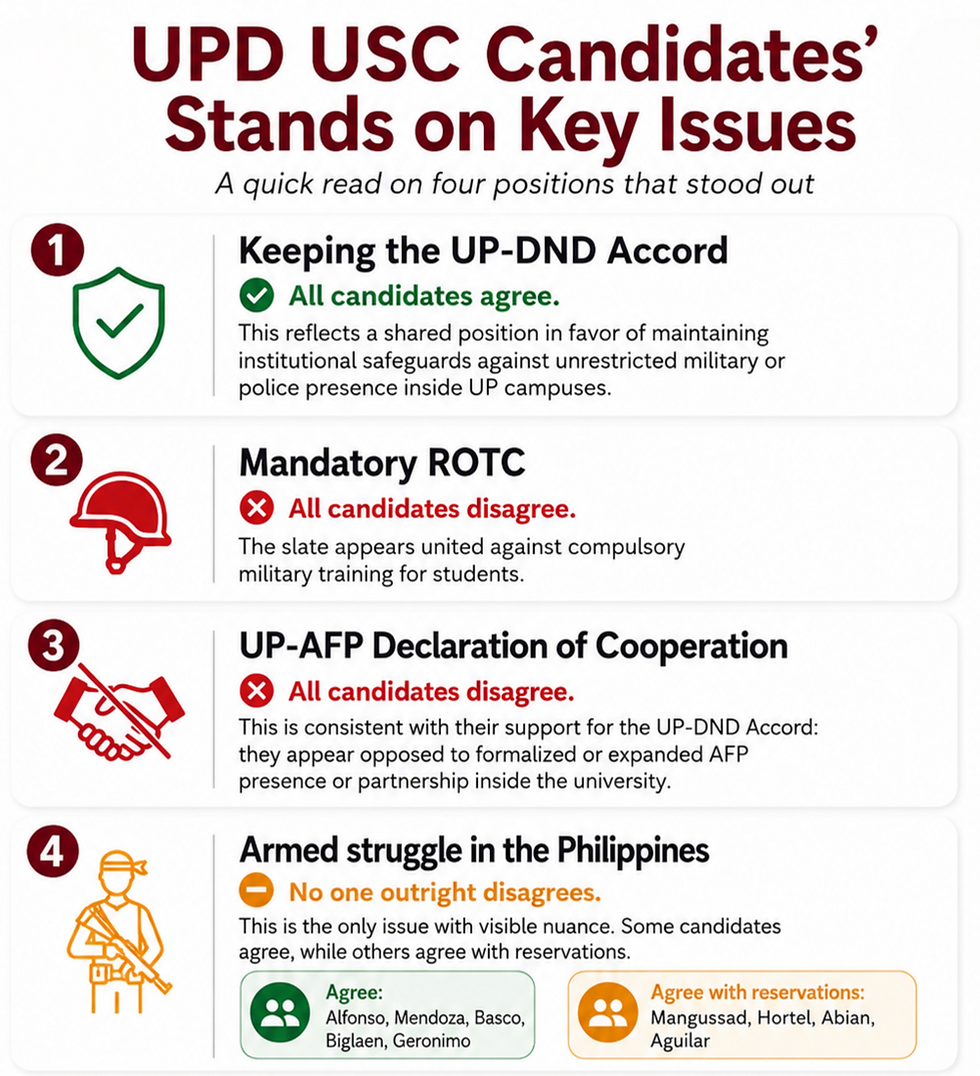
But a healthy freedom of ideas should also show a genuine diversity of thought. In this case, there was almost no visible disagreement on the most sensitive issues. All candidates supported the UP-DND Accord. All opposed Mandatory ROTC. All rejected the UP-AFP cooperation declaration. And on armed struggle, the spectrum was not between agreement and disagreement, but only between agreement and agreement with reservations.
That is not necessarily proof of coercion. But it does suggest an ideological environment where certain positions have become default, and where openly rejecting armed struggle may now be treated as politically unacceptable.
The contradictions become even more glaring whenever UP students die in armed encounters.
Take the recent deaths of Alyssa Alano and Maureen Santuyo in Toboso, Negros Occidental. Almost immediately, narratives emerged portraying them merely as “activists,” obscuring allegations and circumstances linking them to armed revolutionary activity. Why the hesitation to confront the possibility directly? Why sanitize the political realities surrounding these deaths?
If UP student leaders openly affirm armed struggle, then why deny the consequences when students eventually participate in it?
One cannot simultaneously glorify armed revolution while distancing oneself from its human cost.
This is precisely why the romanticization of armed struggle inside universities is dangerous. It creates an environment where violence becomes intellectually defensible but personally distant—where students are encouraged to admire revolution without understanding its brutality, permanence, or victims.
The Philippines has already spent decades bleeding from communist terrorism. Thousands have died including soldiers, rebels, activists, indigenous peoples, civilians, farmers, and students themselves. Entire regions have endured cycles of displacement, extortion, killings, and trauma.
To reduce all this into a fashionable ideological posture inside campus politics is irresponsible.
Universities should remain spaces for critical thinking, dissent, and political debate. But critical thinking also demands moral honesty. And moral honesty requires acknowledging that armed struggle in the Philippine context has left deep wounds on the nation—wounds still carried most heavily by conflict-affected communities.
The real question now is no longer whether students are free to hold controversial ideas. They are, and they should be. The real question is whether UP student politics still provides enough space for students to reject armed struggle without being isolated, branded, or treated as enemies of the movement.
The real question now is no longer whether the influence of the Communist Party of the Philippines persists within UP student politics. The forum may already have answered that. The question is whether UP’s student leaders are prepared to confront the consequences of the ideas they have, for decades, defended at the cost of lives and futures.

Mga Komento