

What Walden Bello gets right—and wrong—about the real threat to our democracy and national security
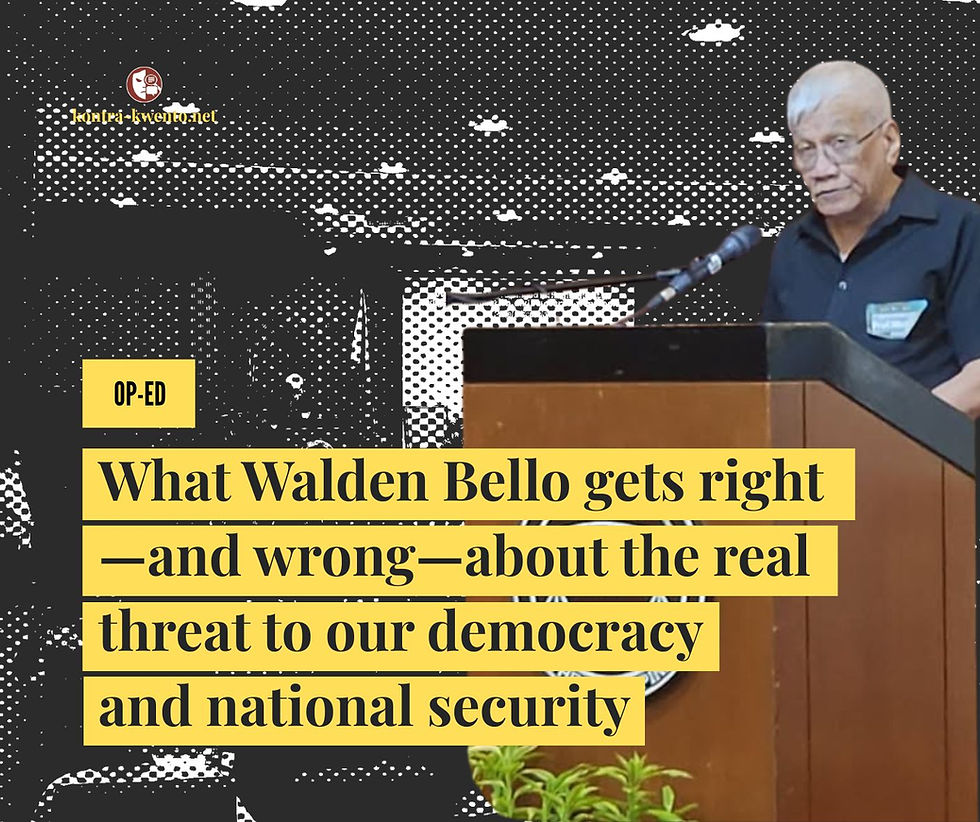
Walden Bello is right about one important thing: democracy suffers when military institutions escape meaningful civilian supervision. Red-tagging, abusive prosecutions, unlawful operations, and unexplained deaths allegedly attributed to counterinsurgency must be independently investigated. No invocation of “national security” should place the Armed Forces of the Philippines beyond the Constitution or the law.
But Bello turns that legitimate warning into a monopoly of blame.
In his speech at the Katungod Conference on July 15 at the University of the Philippines at Diliman, he declared that the AFP is a "threat to democracy and national security." That conclusion is too sweeping. And his treatment of the Talaingod 13 is also too politically convenient, if not downright lazy.
Bello condemns the conviction as “lawfare” without confronting the possibility that the November 2018 operation was not simply a spontaneous “humanitarian rescue.” He refuses to examine whether the Talaingod minors and their predicament were being incorporated into the Communist Party of the Philippines and the New People’s Army's larger struggle for organizational survival in Southern Mindanao.
The real threat exposed by the Talaingod controversy is the CPP-NPA’s bullheaded insistence on exploiting the Lumad struggle, parliamentary campaigns, and other humanitarian issues to preserve, or even resurrect, an armed revolution crumbling under the pressure of internal and external challenges and steadily losing its mass base and political relevance.
This omission is especially striking because Bello himself supplied the standard by which the incident should be judged.
During a Reddit question-and-answer session in 2025, he wrote: “The more important thing right now is the left is so marginalized because it is split up. The process of reunification must begin but around a vision and platform that really speaks to the people rather than being ideologically correct. Ideological correctness has been the bane of the left everywhere.”
Now apply Bello’s own test to Talaingod. Did the decision to move underage children through insecure territory on the night of November 28, 2018 genuinely speak to the children, their parents, and their communities? Or did it conform primarily to what CPP-NPA considered necessary under the pressure of counterinsurgency?
That is the question Bello avoids. And he should know better.
The issue is not whether France Castro, Satur Ocampo et al believed they were helping. Humanitarian concern and political purpose can coexist. People can act sincerely while participating in an operation whose larger objectives they do not fully control, or whose risks they have subordinated to what they consider a higher political necessity. Or democratic centralism.
The facts cannot be dismissed as “lawfare”
To reiterate: The courts found that the accused transported 14 minors without sufficient authority and exposed them to danger. The Regional Trial Court convicted 13 mission participants under Section 10(a) of Republic Act 7610. The Court of Appeals subsequently upheld the conviction, although the ruling remains under legal challenge.
The defense contends the children were being rescued from threats created by the Alamara paramilitary group and the forced closure of the 21 Salugpongan schools. That context deserves serious consideration. Not just because of the involvement of the Alamara or the closure of the schools, but because the Lumad themselves have said repeatedly, with consistent resolve, that the schools and their evacuation were part of the CPP-NPA’s base building and defense strategy in Southern Mindanao.
When do we stop listening to the supposed persecution of the few and start listening to the real stories of an entire indigenous tribe? And Bello cannot make the factual findings disappear by pronouncing the word “lawfare.”
Lawfare is an allegation about the misuse of legal processes. It is not an answer to every uncomfortable question concerning parental authority, child protection, operational planning, and political motive.
Were the parents adequately informed? Who authorized the transfer? Why were minors moved at night through insecure routes? What safeguards had been prepared? What was the destination and what would have happened to the children after their arrival? Most importantly, who made the political decision behind the operation?
Bello’s speech answers none of these questions.
The political objective behind the “rescue”
The 2018 mission occurred amid the closure of Salugpongan schools, the supposed decision of the communities to evacuate in the face of intensified military operations, and severe pressure on the CPP-NPA’s mass base and Party structures in Southern Mindanao.
Testimonies from former cadres of the CPP-SMRC’s White Area Committee say that the operation cannot be separated from the movement’s need to protect its political networks, preserve its influence among Indigenous communities, and generate a broader political and financial campaign against the government’s counterinsurgency.
This does not mean the grievances of the Lumad were invented. Militarization, displacement, poverty, land conflicts, and abuses by armed actors were real. But the more difficult and less asked question is whether those legitimate grievances were treated as ends in themselves or as political resources in somebody else’s protracted war.
The CPP has never concealed its view of parliamentary and legal struggle. Its own ideological writings declare that, between armed struggle and parliamentary struggle, armed struggle is “principal” while parliamentary struggle is “secondary”.
It is therefore not red-tagging to ask whether a parliamentary or humanitarian campaign was being used to protect, support, or rehabilitate the armed movement. It becomes red-tagging only when association is substituted for evidence and political criticism is automatically converted into criminal guilt.
Bello, a former CPP member himself who broke with the organization over three decades ago, should understand this distinction better than most. Yet he refuses to confront the CPP’s strategic logic by which legitimate sectoral struggles are made subordinate to the requirements of its armed revolution.
He cannot claim that a decision placing children in mortal danger was necessarily “speaking to the people” simply because it was presented as humanitarian solidarity. From the national democratic movement’s perspective, the operation may have been ideologically correct because it sought to protect a beleaguered mass base and preserve Party and NPA structures in Southern Mindanao. But reading Bello’s ideological correctness does not answer whether the decision genuinely served the children, their families, and their communities.
That is precisely the contradiction Bello identified in his Reddit response, but now declines to recognize in the case of the so-called Talaingod 13.
The inconvenient story of Haran
The conditions at the United Church of Christ of the Philippines’ Haran deserve more than the heroic imagery attached to the word “sanctuary.”
A Commission on Human Rights inquiry found credible evidence of militarization and abuses by soldiers and the Alamara paramilitary group. It also found indications of cooperation between the military and Alamara. Those findings must not be minimized.
But the same CHR report also recorded testimony that some Lumad “were promised sacks of rice, kitchen utensils, farming implements, a few thousand pesos, and an audience with politicians and a boxing idol. Their hardship and lack of education made it easy to entice them to come down to the City.” That finding complicates the claim that every person in Haran freely entered, and continuously supported, a single political narrative.
Nearly 700 people were living in Haran during the CHR inquiry, 62 percent of them children. In 2021, 156 Lumad residents returned to Talaingod after approximately six years in the compound.
Their advocates said they returned to defend their ancestral territory despite continuing militarization. The military claimed that they had been prevented from leaving. Former cadres and some returning families have provided other accounts involving disillusionment, political control, and the conditions inside the compound.
But there was a fact more tragic than displacement itself, and one that Bello understandably could not have known: more than a dozen deaths occurred in Haran, far exceeding the three publicly reported in 2020, including those of two infants. More importantly, several former cadres of the CPP-SMRC’s White Area Committee, together with surviving family members, have testified that some of these deaths were preventable.
Their accounts point to conditions and decisions inside Haran that must be confronted, not dismissed as military propaganda. The complete story deserves a separate investigation, but the preventable deaths should no longer be treated as speculation. They are part of the lived experience that Bello’s romanticized account of displacement leaves out.
UCCP Haran may have been a genuine sanctuary for some, an intolerable displacement for others, but it was definitely an ideological and political organizing space for the CPP the entire time.
Bello’s ideological blind spot
Bello attacks the AFP for placing counterinsurgency above democracy. Yet former rebels ask why he will not subject the CPP to the same test.
The CPP-NPA’s insistence on preserving an armed struggle with rapidly diminishing popular and military prospects is itself a threat to democratic politics. It encourages the treatment of elections, legislatures, schools, Indigenous campaigns, and humanitarian operations as secondary arenas supporting what the Party considers the principal form of struggle: armed revolution.
That is precisely the ideological correctness Bello once described as the bane of the Left.
If the removal of the Talaingod children for the CPP was considered ideologically correct because it protected a threatened organizational base and generated a nationwide campaign against counterinsurgency, that still does not answer whether it was what the children, their parents, and the wider community wanted. Or whether the risks imposed upon them were justified.
Until Bello and other former CPP members categorically confront this question, their attacks on government counterinsurgency will inadvertently provide political cover to the revolutionary orthodoxy they actually rejected.
They must be willing to state clearly whether legal and parliamentary struggles should be independent democratic engagements or instruments for preserving the armed revolution. They must also tell the public what political strategy pushed Castro, Ocampo, and the other participants to undertake the Talaingod operation in 2018.
Without that reckoning, Bello’s otherwise impassioned defense of democracy will benefit the movement whose authoritarian practices he once condemned.
Two institutions moving in different directions
The AFP has, and will always have, its flaws. It must answer for its excesses, particularly the abuses committed during counterinsurgency campaigns. But presenting the AFP and CPP-NPA as institutions moving along parallel paths in order to actively battle each other ignores what thousands of former rebels have experienced.
For former NPA combatants who were allowed to live, return to their families, and receive opportunities for reintegration, the difference is profound. However imperfectly, they feel that the AFP has begun reckoning with its past and repairing some of the damage caused by decades of conflict.
Thousands of former combatants who once regarded soldiers as mortal enemies are now being given opportunities to rebuild their lives. They have been reunited with their families, assisted in returning to their communities, connected with government programs, and increasingly recognized as partners in peacebuilding.
These interventions remain incomplete and uneven. Some former rebels continue to struggle with poverty, stigma, trauma, and delayed assistance. But their existence demonstrates a significant institutional shift: former enemies are increasingly being treated as citizens who can return, recover, participate, and become partners in democratic society.
The CPP-NPA, meanwhile, remains trapped in the punitive practices of the past. In documented cases drawn from the movement’s own communiqués and media reports, Buklod Kapayapaan, the national federation of former rebel organizations, says that the NPA has acknowledged the summary killing of at least 60 civilians it accused of being “spies” or “informants.”
These people, including elderlies, were denied an independent investigation, legal representation, and a fair trial. The CPP-NPA served as accuser, investigator, judge, and executioner. The label of “spy” became both the allegation and the death sentence.
The contrast is therefore not between a flawless AFP and a flawless revolutionary movement. It is between an institution attempting, however unevenly, to reform and reintegrate its former enemies, and a movement still flogging the dead horse of armed insurgency in the hope of reviving it.
Tell the whole story of Talaingod
Bello is right to insist that military power must be restrained. He is wrong to suggest that only the military threatens democracy.
The deeper threat is any organization, state or insurgent, that places its institutional survival and ideological objectives above the people it proudly says it serves.
In Talaingod, Bello sees only the state’s possible instrumentalization of Lumad lives. He remains conspicuously silent about their documented instrumentalization by the national democratic movement.
If Bello genuinely wants a Left that speaks to the people instead of merely being ideologically correct, he should begin by allowing the complete story of Talaingod to be told, not by him, but by the Lumad communities and former rebels. Who made the decisions, what political objectives were being pursued, what the parents understood, why minors were exposed to danger, and what eventually happened to the families displaced to Haran.
By all means, demand accountability from the AFP. Reject red-tagging, fabricated evidence, and abusive prosecutions. Continue improving reintegration and ensure that former rebels receive the assistance promised to them.
But accountability cannot be demanded selectively. The CPP-NPA must also be held responsible for prolonging an increasingly futile war, executing civilians on suspicion of being informants, subordinating open political campaigns to armed strategy, and exploiting indigenous struggles, and Lumad children, to sustain an organization fighting for its own survival.


Mga Komento