

NEWS ANALYSIS | Should Campus Awareness Always be Framed as Surveillance?
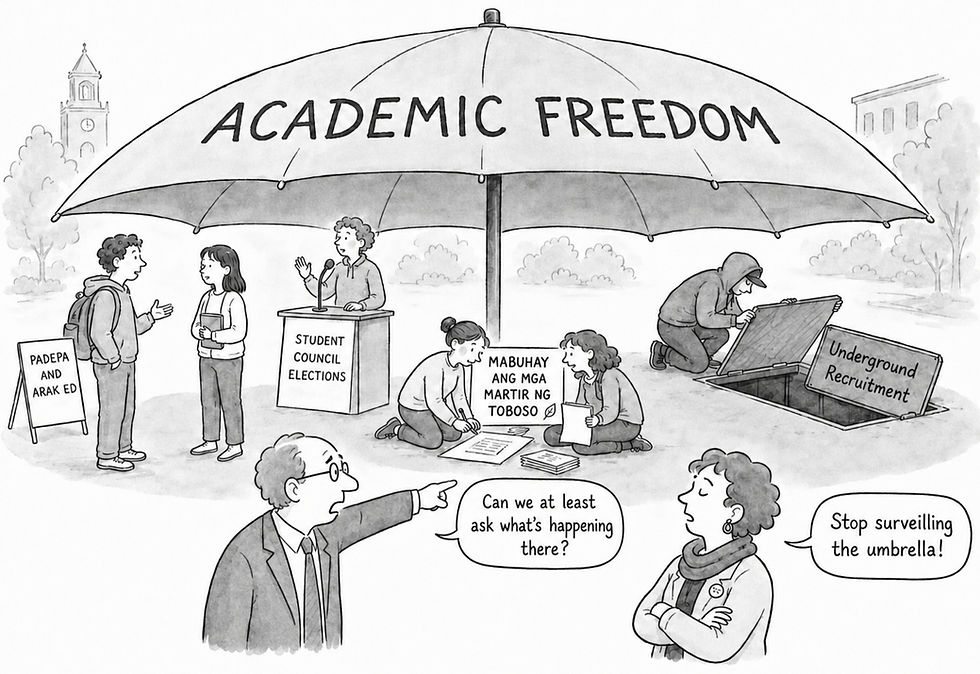
Negros Occidental Governor Eugenio Jose Lacson’s call for school administrators to be more aware of student activities on campus has opened another familiar debate. Where does responsible campus oversight end, and where does political surveillance begin?
The question surfaced after Gov. Lacson urged school officials to be vigilant amid reports of recruitment activities linked to the armed movement. His statement came days after Vince Francis Dingding, a former University of the Philippines Cebu student leader, was among five suspected New People’s Army rebels killed in a May 16 encounter with government troops in Cauayan, Negros Occidental.
Lacson defended his position by saying there was “nothing wrong” with school officials knowing what activities were taking place among young people inside their campuses. He also clarified that his concern was not necessarily about students immediately joining the NPA, but about activities that could eventually lead them in that direction.
Youth groups under the national democratic movement saw it differently. Kabataan Partylist Negros and its Visayas officials warned that the governor’s remarks could encourage schools to act as extensions of the state’s intelligence apparatus. They described the call as a threat to academic freedom and a possible step toward profiling student activists.
The reaction was not surprising. In the Philippines, any discussion involving campus activism, insurgent recruitment, and government monitoring almost always triggers old wounds. Student organizations, notably those from the national democratic movement, have long resisted alleged state intrusion into universities and schools where political dissent is part of campus life. At the same time, former rebels, especially those who were former campus activists, have always maintained that recruitment into the armed movement often passes through legal, political, and cultural activities before reaching the underground.
This is where the debate becomes more difficult than either side usually admits.
School administrators are not strangers to oversight. Campuses regulate organizations, approve activities, monitor security, enforce student codes, and account for outside speakers or events. These are not extraordinary functions. They are part of institutional responsibility, especially when activities involve minors, outside groups, travel, fundraising, or political exposure work.
But vigilance becomes problematic when it is vague, unchecked, or politically selective. If “monitoring” becomes a license to intimidate students, collect names without cause, pressure teachers, or treat dissent as evidence of rebellion, then the concern of student groups becomes valid. Academic freedom cannot survive in a campus culture where students feel that every forum, petition, or community visit may be treated as suspicious.
The harder question is whether all forms of awareness should automatically be treated as surveillance.
There is a difference between a school knowing what organizations are doing on campus and a school profiling students for their beliefs. There is a difference between checking whether an activity has proper authorization and assuming that every activist group is a recruitment pipeline. There is also a difference between protecting students from manipulation and suppressing political criticism.
Former rebels have repeatedly pointed out that recruitment into the underground does not usually begin with an invitation to carry a firearm. It often begins with issue-based discussions, exposure work, study sessions, cultural activities, and political education. None of these are illegal by themselves. Many are legitimate forms of civic engagement. But in some cases, former cadres say, these activities were used as entry points for deeper ideological consolidation and eventual recruitment into clandestine structures.
It should be made clear that when we acknowledge this pattern, we do not automatically criminalize activism. We simply recognize that recruitment can be gradual, layered, and disguised as ordinary organizing.
That is why the public conversation should not be reduced to two extreme positions, as most national democratic organizations are wont to do. It’s always the false binary that campus oversight equals repression. Equally dangerous is the notion that all campus activism is dangerous. Both are lazy shortcuts. The first endangers democratic space. The second ignores the lived experiences of families, former rebels, and communities that have seen young people move from legal activism to the armed underground.
Lacson’s critics are right to demand safeguards. Any campus-based response to recruitment concerns must be transparent, rights-based, and clearly limited. Students should not be harassed for joining organizations, attending forums, criticizing government, or supporting causes. Schools should not become political hunting grounds.
But critics also weaken their own argument when they treat any call for awareness as automatic proof of authoritarian intent. Schools cannot be expected to supervise student welfare while being told to look away from activities happening under their own roof. Administrators have duties not only to protect academic freedom, but also to protect students from exploitation, coercion, unsafe activities, and undisclosed political recruitment.
The issue, then, is not whether schools should be aware. They should be. The issue is how that awareness is exercised.
A responsible approach would require clear policies, such as no blanket labeling of student groups, no collection of political information without basis, no intimidation of faculty or students, and no interference with lawful expression. At the same time, schools should strengthen orientation programs, parental communication, student organization accreditation, safety protocols for off-campus activities, and open discussions on recruitment, radicalization, and democratic participation.
That kind of approach does not need drama. It doesn’t need secret lists or public shaming. It needs honest education, accountable administration, and a willingness to discuss uncomfortable realities without turning every disagreement into a propaganda war.
The deaths of former activist youths in armed encounters should not be used to silence student activism. But neither should the language of academic freedom be used to shut down questions about how these young people have been drawn into armed struggle in the first place.
Campus freedom and student protection are not enemies. They are both necessary.
The challenge for schools, local governments, and student groups is to hold both principles at the same time: defend the right of the youth to think, organize, and dissent, while refusing to ignore the real pathways through which political idealism can be redirected toward violence.
Sometimes, awareness is not surveillance. Sometimes, it is simply the minimum duty of institutions responsible for young lives. But for that awareness to earn public trust, it must be exercised with restraint, fairness, and respect for rights. Otherwise, even a legitimate concern can easily become the very abuse its critics fear.


Mga Komento