

The Roles that Cumpio, Domequil, Abinguna that the UN Opinion Glossed Over
Cumpio, Domequil and Abinguna may have performed real public work. That does not rule out the fact that they also served the CPP's underground structure.

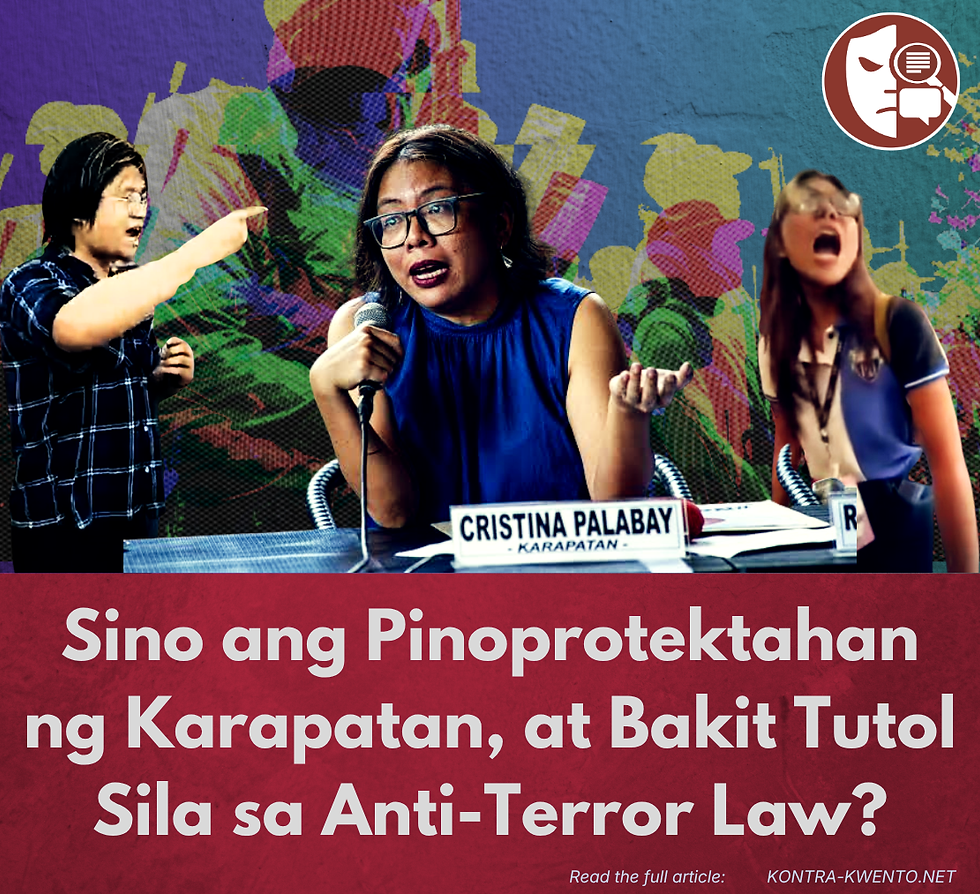
Following the recent United Nations Working Group's Opinion No. 22/2026, the cases involving Frenchie Mae Cumpio, Marielle Domequil and Alexander Abinguna have again brought into focus whether they were prosecuted for their legitimate work as a journalist, church worker and human-rights defender, or for alleged participation in the CPP’s underground apparatus. Former rebels who worked directly with the three, however, challenge that “false dichotomy.” They contend that legitimate public work and clandestine CPP assignments existed side by side.
To Jerome and Erin, former cadres of the Communist Party of the Philippines and the New People’s Army in the Visayas, the opinion missed the very point which allowed the CPP-NPA to operate within the established legal democratic framework in the country. A journalist can also hold a clandestine political assignment and a church worker can also handle funds for an underground organization, Jerome reveals. Erin says a human rights worker can also serve in a revolutionary structure. Their public roles may be genuine, but so are their underground ones.
That simple fact is the heart of the case involving Frenchie Mae Cumpio, Marielle Domequil and Alexander Abinguna. Supporters describe them, perhaps correctly, by the work for which the public knows them: journalist, church worker and human-rights worker. The United Nations Working Group on Arbitrary Detention used the same frame when it declared their detention arbitrary and called for their release.
But those labels do not settle the central factual dispute. The real question is whether public work was their whole identity, or whether it existed beside assignments in the CPP's urban apparatus, work that former rebels say supported the NPA's armed struggle.
What Judge Perez actually decided
Presiding Judge Georgina Uy Perez of Regional Trial Court Branch 45 in Tacloban confronted that distinction in the case against Cumpio and Domequil. The court convicted both women under Section 8(ii) of Republic Act No. 10168, which punishes making property, funds or related services available to a designated person or organization.
The conviction was not based on Cumpio's journalism or Domequil's church work. It rested on a specific alleged act: a March 29, 2019 delivery in Barangay San Andres, Catbalogan City of P100,000, ammunition and other supplies to an NPA member known as "Butil."

Four former rebels testified about that delivery. A fifth described the accused women's alleged underground work and meetings. The defense attacked the witnesses as military assets, pointed to the absence of photographs and documentary proof of the handover, and offered digital activity meant to place the women elsewhere. Judge Perez nevertheless found the prosecution witnesses credible and materially consistent. She also found that the online activity did not establish the women's precise location when the transfer allegedly occurred.
Each woman was sentenced to an indeterminate prison term of 12 years, five months and 11 days to 18 years, eight months and one day, and fined P500,000. The court denied reconsideration and bail on March 25. Their appeal is pending before the Court of Appeals, so the conviction is not yet final.
The important point is narrower than the verdict itself. Judge Perez did not treat "journalist" and "church worker" as answers to the accusation. She asked whether the women also knowingly performed work for an organization engaged in armed struggle. She concluded that the evidence proved they did.
‘It was their cover’
Two former members of the revolutionary movement gave Kontra-Kwento accounts that echoed the organizational picture accepted by the court.
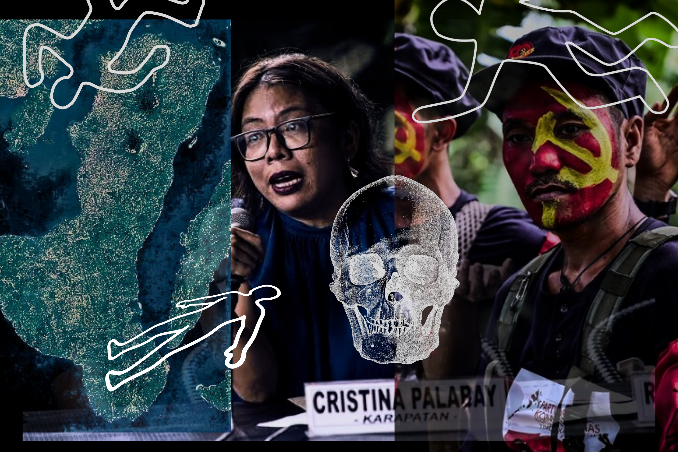
Jerome said he personally relayed an internal decision appointing Cumpio as the secretary of Eastern Visayas’ Regional White Area Committee, or RWAC, around 2016. Former rebels describe the RWAC as the regional CPP body responsible for ideological, political and organizational work in urban or legal spaces. It is not an NPA fighting unit. But its work directly supports the underground network, especially the NPA, through organization, propaganda, finance, liaison, transport and other tasks.
Jerome said Cumpio's direct NPA link was with "Front Damol," which he described as a special formation operating mainly from western Samar and supporting inter-island movement, regional liaison, transport and communications.
Erin, meanwhile, said she knew Cumpio by her nom de guerre "Pam." She said Cumpio was RWAC secretary around 2018 when she met her inside an NPA unit that served as the CPP’s regional headquarters. Erin also revealed that Abinguna or “Ka Chakoy” was with Cumpio at the time. The two, Erin said, were attending a meeting being hosted by the regional headquarters.
“Then after nun, sumama sila pabalik ng Emporium, sumama sila sa akin tapos may mga sulat silang dala. That time eh nung sumama sila sa akin from kampo ng Region papunta doon sa kampo ng SRC Emporium, may dala silang mga baril.” Emporium, per Jerome and Erin, is a subregional committee in Northern Samar.
Erin also recalled that, as an NPA fighter, she coordinated with Domequil in organizing a CPP-led rally in the Catubig-Las Navas area. By then, Erin said Domequils was also functioning as finance officer for the RWAC.
Both Erin and Jerome challenged the claim that the Cumpio, Domequil and Abinguna were outsiders to the underground movement simply because their public work was real. “It was their cover,” Erin said. She and Jerome said that the three were public-facing activists who also occupied positions in a clandestine CPP structure connected to the regional armed movement.
What the UN opinion glossed over
The UN Working Group's Opinion No. 22/2026 raised serious concerns. Cumpio, Domequil and Abinguna had already spent more than six years in detention. The Working Group found their detention arbitrary and called for immediate release, compensation and an independent investigation. The Philippine government made its own position weaker by failing to answer the Working Group's October 2025 communication.
But the opinion went further, unfortunately, to its detriment. It described the charges as lacking factual or legal foundation and treated the acquittal, dismissal and delay as evidence of politically motivated persecution. In doing so, however, it did not seriously engage the distinction that Judge Perez succinctly addressed: public work and underground work can and do coexist.
Nor did it confront the evidence that persuaded the RTC in the separate terrorism-financing case, such as the former-rebel witnesses, the 2019 delivery and the court's rejection of the defense's location evidence. The Working Group is a UN human-rights mechanism, not a Philippine appellate court. Its opinion is an important international assessment of detention and fair-trial rights, but it does not overturn the RTC judgment.
The same caution applies to Abinguna. Judge Perez did not convict him in the financing case. Claims about his underground role here come from former-rebel interviews and from his separate, still-pending case.
Documented history
The “symbiotic relationship” between a public profession and an underground revolutionary role has been documented throughout the years, especially by the CPP-NPA and its political arm National Democratic Front of the Philippines.
The NDFP’s own program calls for the coordination of legal and illegal, aboveground and underground forms of struggle. It identifies armed struggle as the principal form while describing the legal democratic movement as indispensable. Under this framework, public advocacy and clandestine revolutionary activity are treated as different parts of the same political strategy.
This relationship is made more explicit in an official NDFP article on its allied organizations. For instance, it identifies Artista at Manunulat para sa Sambayanan (ARMAS) as the organization for artists, cultural and media workers; Christians for National Liberation (CNL) for religious and church workers, and Lupon ng mga Manananggol para sa Bayan (LUMABAN) for lawyers and legal practitioners.
Julie de Lima’s NDFP essay, “On the Pen and the Gun,” likewise presents propaganda and armed struggle as complementary weapons and recounts how revolutionary organizers recruited journalists and writers. The article identifies former Philippine Collegian editor Antonio Tagamolila as a clandestine Party member and says filmmaker Lino Brocka was among three clandestine Party members appointed to the 1986 Constitutional Commission. An NDFP publication similarly recounts how Divine “Ka Zoe” Sureta, an Indigenous leader who had worked at the National Commission on Indigenous Peoples and served as a teacher, joined the NPA in 2016 and later worked as its medic and educator.
In a tribute issued by its Central Committee, the CPP identified Luis “Ka Louie” Jalandoni, once a Catholic priest, as a founder of Christians for National Liberation in February 1972 and said that he joined the CPP the following month. Jalandoni later became the chief negotiator of the NDFP in peace negotiations between the CPP-NPA-NDFP and the Government of the Republic of the Philippines.

While not every journalist, church worker, lawyer or human-rights advocate is connected to the underground movement, it would be foolish to insist that Cumpio, Domequil or Abinguna are mere activists and had no direct or indirect involvement in the underground, especially armed, movement of the CPP-NPA.The CPP-NDFP’s literature and its accounts of its own members themselves disprove that legitimate public work and an underground revolutionary assignment cannot coexist. A person may genuinely be a journalist, church worker or human-rights defender and,, may also be performing an underground role that advances the armed struggle.
The simpler, more credible account
True, the security sector may have mishandled evidence. The firearms acquittal and the forfeiture reversal give the public reason to ask hard questions about searches, documentation and chain of custody. Judge Perez's conviction may still be reversed on appeal. The former rebels, including Erin and Jerome, may be challenged, contradicted or disbelieved.
Cumpio, Jerome insists, is indeed a journalist, just like Tagamolila. Domequil may truly have been a church worker, just like Jalandoni. Abinguna may truly have been a human-rights worker, just like Sureta. The question is whether those were their only roles.
Judge Perez understood that distinction in the case before her. She judged Cumpio and Domequil not for their public professions but for what she found to be deliberate support for an armed movement.
The UN Working Group was right to examine prolonged detention and fair-trial failures. But when it portrayed the prosecutions as devoid of factual basis, it glossed over the part of the record that does not fit the simple “advocacy story.” For it to be credible and attuned to the realities on the ground, it must wise up to the simpler fact that in the Philippine context, public service and clandestine CPP-NPA work are not mutually exclusive.

Mga Komento